|
| Purgatory |
| Thursday, March 26, 2009 |
"I don’t believe in purgatory, because it is not mentioned in the Bible! There exists only heaven and hell!"

the Fathers: Tertullian, The Soul (Inter 208-212 A.D.): "In short, if we understand that prison of which the Gospel speaks to be Hades, and if we interpret the last farthing to be the light offense which is to be expiated there before the resurrection, no one will doubt that the soul undergoes some punishments in Hades, without prejudice to the fullness of the resurrection, after which recompense will be made through the flesh also." Tertullian, Monogamy (Post 213 A.D.): "A woman, after the death of her husband, is bound not less firmly but even more so, not to marry another husband...Indeed, she prays for his soul and asks that he may, while waiting, find rest; and that he may share in the first resurrection. And each year, on the anniversary of his death, she offers the sacrifice." St. Cyprian of Carthage, Letter to His Clergy and to All His People (250 A.D.): "Lawrence and Ignatius, though they fought betimes in worldly camps, were true and spiritual soldiers of God; and while they laid the Devil on his back with their confession of Christ, they merited the palms and crowns of the Lord by their illustrious passion. We always offer sacrifices for them, as you will recall, as often as we celebrate the passions of the martyrs by commemorating their anniversary day." St. Cyril of Jerusalem, Catechetical Lectures (C. 350 A.D.): "Then we make mention also of those who have already fallen asleep: first, the patriarchs, prophets, Apostles, and martyrs, that through their prayers and supplications God would receive our petition; next, we make mention also of the holy fathers and bishops who have already fallen asleep, and, to put it simply, of all among us who have already fallen asleep; for we believe that it will be of very great benefit to the souls of those for whom the petition is carried up, while this holy and most solemn Sacrifice is laid out." St. Gregory of Nyssa, Sermon on the Dead (383 A.D.): "After his departure out of the body, he gains knowledge of the difference between virtue and vice, and finds that he is not able to partake of divinity until he has been purged of the filthy contagion in his soul by the purifying fire." St. Augustine of Hippo, The City of God Against the Pagans (Inter 413 - 426 A.D.): "Temporal punishments are suffered by some in this life only, by some after death, by some both here and hereafter; but all of them before that last and strictest judgment." St. Augustine of Hippo, Confessions Bk. IX Ch. II (400 A.D.): St. Augustine’s mother, St. Monica, on her death-bed said to him: "This one request I make of you, that, wherever you be, you remember me at the Lord’s altar." Catechism of the Council of Trent (1566): Prayers for the dead, that they may be liberated from the fire of purgatory, are derived from Apostolic teaching... (The Eucharist)..its benefits extend not only to the celebrant and communicant, but to all the faithful, whether living with us on earth, or already numbered with those who are dead in the Lord, but whose sins have not yet been fully expiated. For, according to the most authentic Apostolic tradition, it is not less available when offered for them, than when offered for the sins of the living, their punishments, satisfactions, calamities and difficulties of every sort. Catechism of the Catholic Church (1992): No. 1030: All who die in God’s grace and friendship, but still imperfectly purified, are indeed assured of their eternal salvation; but after death they undergo purification, so as to achieve the holiness necessary to enter the joy of heaven. No. 1031: The Church gives the name Purgatory to this final purification of the elect, which is entirely different from the punishment of the damned. The Church formulated her doctrine of faith on Purgatory especially at the Councils of Florence and Trent. The tradition of the Church, by reference to certain texts of Scripture, speaks of a cleansing fire: As for certain lesser faults, we must believe that, before the Final Judgment, there is a purifying fire. He who is truth says that whoever utters blasphemy against the Holy Spirit will be pardoned neither in this age nor in the age to come. From this sentence we understand that certain offenses can be forgiven in this age, but certain others in the age to come (St. Gregory the Great,Dial. 4, 39: PL 77, 396) . No. 1032: This teaching is also based on the practice of prayer for the dead, already mentioned in Sacred Scripture: "Therefore [Judas Maccabeus] made atonement for the dead, that they might be delivered from their sin" (2 Maccabees 12, 46). From the beginning the Church has honored the memory of the dead and offered prayers in suffrage for them, above all the Eucharistic sacrifice, so that, thus purified, they may attain the beatific vision of God. The Church also commends almsgiving, indulgences, and works of penance undertaken on behalf of the dead: Let us help and commemorate them. If Job’s sons were purified by their father’s sacrifice, why should we doubt that our offerings for the dead bring them some consolation? Let us not hesitate to help those who have died and to offer our prayers for them (St. John Chrysostom,Hom. in 1 Cor. 41, 5: PG 61, 361). Labels: THE PROFESSION OF FAITH |
posted by Bro. Terence @ 12:40 AM   |
|
|
|
| What is to Be Replied to Those Who Think that Resurrection Pertains Only to Bodies and Not to Souls. St. Augustine |
| Wednesday, March 25, 2009 |
What is to Be Replied to Those Who Think that Resurrection Pertains Only to Bodies and Not to Souls.
There are some who suppose that resurrection can be predicated only of the body, and therefore they contend that this first resurrection (of the Apocalypse) is a bodily resurrection. For, say they, to rise again can only be said of things that fall. Now, bodies fall in death. There cannot, therefore, be a resurrection of souls, but of bodies. But what do they say to the apostle who speaks of a resurrection of souls? For certainly it was in the inner and not the outer man that those had risen again to whom he says, If you have risen with Christ, mind the things that are above. Colossians 3:1 The same sense he elsewhere conveyed in other words, saying, That as Christ has risen from the dead by the glory of the Father, so we also may walk in newness of life. Romans 6:4 So, too, Awake you that sleepest, and arise from the dead, and Christ shall give you light. Ephesians 5:14 As to what they say about nothing being able to rise again but what falls, whence they conclude that resurrection pertains to bodies only, and not to souls, because bodies fall, why do they make nothing of the words, You that fear the Lord, wait for His mercy; and go not aside lest ye fall; Sirach 2:7 and To his own Master he stands or falls; Romans 14:4 and He that thinks he stands, let him take heed lest he fall? 1 Corinthians 10:12 For I fancy this fall that we are to take heed against is a fall of the soul, not of the body. If, then, rising again belongs to things that fall, and souls fall, it must be owned that souls also rise again. To the words, In them the second death has no power, are added the words, but they shall be priests of God and Christ, and shall reign with Him a thousand years; and this refers not to the bishops alone, and presbyters, who are now specially called priests in the Church; but as we call all believers Christians on account of the mystical chrism, so we call all priests because they are members of the one Priest. Of them the Apostle Peter says, A holy people, a royal priesthood. 1 Peter 2:9 Certainly he implied, though in a passing and incidental way, that Christ is God, saying priests of God and Christ, that is, of the Father and the Son, though it was in His servant-form and as Son of man that Christ was made a Priest for ever after the order of Melchisedec. But this we have already explained more than once.Labels: THE PROFESSION OF FAITH |
| posted by Bro. Terence @ 11:46 PM |
|
|
|
| God is present everywhere by: St. Hilary of Poitiers |
|
 "The heaven, which is held in His palm, is again the throne of God, and the earth, which is grasped in His hand, is at the same time His footstool. This is in order that we might not imagine that the throne and the footstool are an extension of a bodily form as in the position of one who is seated, since that which is His throne and footstool the omnipotent infinity itself grasps with its hand and once more embraces, but that in all these beginnings of created things God might be recognized as in them and outside of them, reaching beyond them and being found within them, that is, poured about everything and permeating everything, since what the palm and the hand grasp reveal the power of His external nature, and the throne and the footstool show that external things are subject to Him as the One who is within, since He who is within rests upon the things that are without. Thus, He Himself with His whole being contains all things that are within Him and outside of Him, nor is He, the infinite One, separated from all things nor are all things not present within Him who is infinite. My mind, intent on the study of truth, took delight in these most pious teachings about God. For it did not consider any other thing worthy of God than that He is so far beyond the power of comprehension that the more the infinite spirit would endeavor to encompass Him to any degree, even though it be by an arbitrary assumption, the more the infinity of a measureless eternity would surpass the entire infinity of the nature that pursues it. Although we understood this teaching in a reverent manner, it was clearly confirmed by these words of the Prophet: 'Whither shall I go from thy spirit? Or whither shall I flee from thy face? If I ascend into heaven thou art there: if I descend into hell thou art present. If I take my wings early in the morning, and dwell in the uttermost parts of the sea even there also shall thy hand lead me and thy right hand shall hold me.' There is no place without God, nor is there any place which is not in God. He is in heaven, in hell, and beyond the seas. He is within all things; He comes forth and is outside all things. While He thus possesses and is possessed, He is not included in anything nor is He not in all things." Labels: THE PROFESSION OF FAITH |
| posted by Bro. Terence @ 10:15 AM |
|
|
|
| That the Holy Spirit is Very God, Equal with the Father and the Son . by St. Augustine. |
| Tuesday, March 24, 2009 |
That the Son is Very God, of the Same Substance with the Father. Not Only the Father, But the Trinity, is Affirmed to Be Immortal. All Things are Not from the Father Alone, But Also from the Son. That the Holy Spirit is Very God, Equal with the Father and the Son.

9. They who have said that our Lord Jesus Christ is not God, or not very God, or not with the Father the One and only God, or not truly immortal because changeable, are proved wrong by the most plain and unanimous voice of divine testimonies; as, for instance, In the beginning was the Word, and the Word was with God, and the Word was God. For it is plain that we are to take the Word of God to be the only Son of God, of whom it is afterwards said, And the Word was made flesh, and dwelt among us, on account of that birth of His incarnation, which was wrought in time of the Virgin. But herein is declared, not only that He is God, but also that He is of the same substance with the Father; because, after saying, And the Word was God, it is said also, The same was in the beginning with God: all things were made by Him, and without Him was not anything made. Not simply all things; but only all things that were made, that is; the whole creature. From which it appears clearly, that He Himself was not made, by whom all things were made. And if He was not made, then He is not a creature; but if He is not a creature, then He is of the samesubstance with the Father. For all substance that is not God is creature; and all that is not creature is God. And if the Son is not of the same substance with the Father, then He is a substance that was made: and if He is a substance that was made, then all things were not made by Him; but all things were made by Him, therefore He is of one and the same substance with the Father. And so He is not only God, but also very God. And the same John most expressly affirms this in his epistle: For we know that the Son of God is come, and has given us an understanding, that we may know the true God, and that we may be in His true Son Jesus Christ. This is the true God, and eternal life. 10. Hence also it follows by consequence, that the Apostle Paul did not say, Who alone has immortality, of the Father merely; but of the One and only God, which is the Trinity itself. For that which is itself eternal life is not mortal according to any changeableness; and hence the Son of God, because He is Eternal Life, is also Himself understood with the Father, where it is said, Who only has immortality. For we, too, are made partakers of this eternal life, and become, in our own measure, immortal. But the eternal life itself, of which we are made partakers, is one thing; we ourselves, who, by partaking of it, shall live eternally, are another. For if He had said, Whom in His own time the Father will show, who is the blessed and only Potentate, the King of kings, and Lord of lords; who only has immortality; not even so would it be necessarily understood that the Son is excluded. For neither has the Son separated the Father from Himself, because He Himself, speaking elsewhere with the voice of wisdom (for He Himself is the Wisdom of God), says, I alone compassed the circuit of heaven. And therefore so much the more is it not necessary that the words, Who has immortality, should be understood of the Father alone, omitting the Son; when they are said thus: That you keep this commandment without spot, unrebukeable, until the appearing of our Lord Jesus Christ: whom in His own time He will show, who is the blessed and only Potentate, the King of kings, and Lord of lords; who only has immortality, dwelling in the light which no man can approach unto; whom no man has seen, nor can see: to whom be honor and power everlasting. Amen. In which words neither is the Father specially named, nor the Son, nor the Holy Spirit; but the blessed and only Potentate, the King of kings, and Lord of lords; that is, the One and only and true God, the Trinity itself. 11. But perhaps what follows may interfere with this meaning; because it is said, Whom no man has seen, nor can see: although this may also be taken as belonging to Christ according to His divinity, which the Jews did not see, who yet saw and crucified Him in the flesh; whereas His divinity can in no wise be seen by human sight, but is seen with that sight with which they who see are no longer men, but beyond men. Rightly, therefore, is God Himself, the Trinity, understood to be the blessed and only Potentate, who shows the coming of our Lord Jesus Christ in His own time. For the words, Who only has immortality, are said in the same way as it is said, Who only does wondrous things. And I should be glad to know of whom they take these words to be said. If only of the Father, how then is that true which the Son Himself says, For what things soever the Father does, these also does the Son likewise? Is there any, among wonderful works, more wonderful than to raise up and quicken the dead? Yet the same Son says, As the Father raises up the dead, and quickens them, even so the Son quickens whom He will. How, then, does the Father alone do wondrous things, when these words allow us to understand neither the Father only, nor the Son only, but assuredly the one only true God, that is, the Father, and the Son, and the Holy Spirit? 12. Also, when the same apostle says, But to us there is but one God, the Father, of whom are all things, and we in Him; and one Lord Jesus Christ, by whom are all things, and we by Him, who can doubt that he speaks of all things which are created; as does John, when he says, All things were made by Him ? I ask, therefore, of whom he speaks in another place: For of Him, and through Him, and in Him, are all things: to whom be glory for ever. Amen. For if of the Father, and the Son, and the Holy Spirit, so as to assign each clause severally to each person: of Him, that is to say, of the Father; through Him, that is to say, through the Son; in Him, that is to say, in the Holy Spirit—it is manifest that the Father, and the Son, and the Holy Spirit is one God, inasmuch as the words continue in the singular number, To whom be glory for ever. For at the beginning of the passage he does not say, O the depth of the riches both of the wisdom and knowledge of the Father, or of the Son, or of the Holy Spirit, but of the wisdom and knowledge of God! How unsearchable are His judgments, and His ways past finding out! For who has known the mind of the Lord? or who has been His counsellor? Or who has first given to Him and it shall be recompensed unto him again? For of Him, and through Him, and in Him, are all things: to whom be glory for ever. Amen. But if they will have this to be understood only of the Father, then in what way are all things by the Father, as is said here; and all things by the Son, as where it is said to the Corinthians, And one Lord Jesus Christ, by whom are all things, and as in the Gospel of John, All things were made by Him? For if some things were made by the Father, and some by the Son, then all things were not made by the Father, nor all things by the Son; but if all things were made by the Father, and all things by the Son, then the same things were made by the Father and by the Son. The Son, therefore, is equal with the Father, and the working of the Father and the Son is indivisible. Because if the Father made even the Son, whom certainly the Son Himself did not make, then all things were not made by the Son; but all things were made by the Son: therefore He Himself was not made, that with the Father He might make all things that were made. And the apostle has not refrained from using the very word itself, but has said most expressly, Who, being in the form of God, thought it not robbery to be equal with God; using here the name of God specially of the Father; as elsewhere, But the head of Christ is God. 13. Similar evidence has been collected also concerning the Holy Spirit, of which those who have discussed the subject before ourselves have most fully availed themselves, that He too is God, and not a creature. But if not a creature, then not only God (for men likewise are called gods ), but also very God; and therefore absolutely equal with the Father and the Son, and in the unity of the Trinity consubstantial and co-eternal. But that the Holy Spirit is not a creature is made quite plain by that passage above all others, where we are commanded not to serve the creature, but theCreator; not in the sense in which we are commanded to serve one another by love, which is in Greek δουλεύειν, but in that in which God alone is served, which is in Greek λατρεύειν . From whence they are called idolaters who tender that service to images which is due to God. For it is this service concerning which it is said, You shall worship the Lord your God, and Him only shall you serve. For this is found also more distinctly in the Greek Scriptures, which have λατρεύσεις . Now if we are forbidden to serve the creature with such a service, seeing that it is written, You shall worship the Lord your God, and Him only shall you serve (and hence, too, the apostle repudiates those who worship and serve the creature more than the Creator), then assuredly the Holy Spirit is not a creature, to whom such a service is paid by all the saints; as says the apostle, For we are the circumcision, which serve the Spirit of God, which is in the Greek λατρεύοντες . For even most Latin copies also have it thus, We who serve the Spirit of God; but all Greek ones, or almost all, have it so. Although in some Latin copies we find, not We worship the Spirit of God, but, We worship God in the Spirit. But let those who err in this case, and refuse to give up to the more weighty authority, tell us whether they find this text also varied in the mss.: Do you not know that your body is the temple of the Holy Ghost, which is in you, which you have of God? Yet what can be more senseless or more profane, than that any one should dare to say that the members of Christ are the temple of one who, in their opinion, is a creature inferior to Christ? For the apostle says in another place, Your bodies are members of Christ. But if the members of Christ are also the temple of the Holy Spirit, then the Holy Spirit is not a creature; because we must needs owe to Him, of whom our body is the temple, that service wherewith God only is to be served, which in Greek is called λατρεία . And accordingly the apostle says, Therefore glorify God in your body. Labels: THE PROFESSION OF FAITH |
| posted by Bro. Terence @ 11:13 PM |
|
|
|
| Is God Exists? St. Thomas of Aquinas |
|

I answer that, The existence of God can be proved in five ways. The first and more manifest way is the argument from motion. It is certain, and evident to our senses, that in the world some things are in motion. Now whatever is in motion is put in motion by another, for nothing can be in motion except it is in potentiality to that towards which it is in motion; whereas a thing moves inasmuch as it is in act. For motion is nothing else than the reduction of something from potentiality to actuality. But nothing can be reduced from potentiality to actuality, except by something in a state of actuality. Thus that which is actually hot, as fire, makes wood, which is potentially hot, to be actually hot, and thereby moves and changes it. Now it is not possible that the same thing should be at once in actuality and potentiality in the same respect, but only in different respects. For what is actually hot cannot simultaneously be potentially hot; but it is simultaneously potentially cold. It is therefore impossible that in the same respect and in the same way a thing should be both mover and moved, i.e. that it should move itself. Therefore, whatever is in motion must be put in motion by another. If that by which it is put in motion be itself put in motion, then this also must needs be put in motion by another, and that by another again. But this cannot go on to infinity, because then there would be no first mover, and, consequently, no other mover; seeing that subsequent movers move only inasmuch as they are put in motion by the first mover; as the staff moves only because it is put in motion by the hand. Therefore it is necessary to arrive at a first mover, put in motion by no other; and this everyone understands to be God. The second way is from the nature of the efficient cause. In the world of sense we find there is an order of efficient causes. There is no case known (neither is it, indeed, possible) in which a thing is found to be the efficient cause of itself; for so it would be prior to itself, which is impossible. Now in efficient causes it is not possible to go on to infinity, because in all efficient causes following in order, the first is the cause of the intermediate cause, and the intermediate is the cause of the ultimate cause, whether the intermediate cause be several, or only one. Now to take away the cause is to take away the effect. Therefore, if there be no first cause among efficient causes, there will be no ultimate, nor any intermediate cause. But if in efficient causes it is possible to go on to infinity, there will be no first efficient cause, neither will there be an ultimate effect, nor any intermediate efficient causes; all of which is plainly false. Therefore it is necessary to admit a first efficient cause, to which everyone gives the name of God. The third way is taken from possibility and necessity, and runs thus. We find in nature things that are possible to be and not to be, since they are found to be generated, and to corrupt, and consequently, they are possible to be and not to be. But it is impossible for these always to exist, for that which is possible not to be at some time is not. Therefore, if everything is possible not to be, then at one time there could have been nothing in existence. Now if this were true, even now there would be nothing in existence, because that which does not exist only begins to exist by something already existing. Therefore, if at one time nothing was in existence, it would have been impossible for anything to have begun to exist; and thus even now nothing would be in existence---which is absurd. Therefore, not all beings are merely possible, but there must exist something the existence of which is necessary. But every necessary thing either has its necessity caused by another, or not. Now it is impossible to go on to infinity in necessary things which have their necessity caused by another, as has been already proved in regard to efficient causes. Therefore we cannot but postulate the existence of some being having of itself its own necessity, and not receiving it from another, but rather causing in others their necessity. This all men speak of as God. The fourth way is taken from the gradation to be found in things. Among beings there are some more and some less good, true, noble and the like. But "more" and "less" are predicated of different things, according as they resemble in their different ways something which is the maximum, as a thing is said to be hotter according as it more nearly resembles that which is hottest; so that there is something which is truest, something best, something noblest and, consequently, something which is uttermost being; for those things that are greatest in truth are greatest in being, as it is written in Metaph. ii. Now the maximum in any genus is the cause of all in that genus; as fire, which is the maximum heat, is the cause of all hot things. Therefore there must also be something which is to all beings the cause of their being, goodness, and every other perfection; and this we call God. The fifth way is taken from the governance of the world. We see that things which lack intelligence, such as natural bodies, act for an end, and this is evident from their acting always, or nearly always, in the same way, so as to obtain the best result. Hence it is plain that not fortuitously, but designedly, do they achieve their end. Now whatever lacks intelligence cannot move towards an end, unless it be directed by some being endowed with knowledge and intelligence; as the arrow is shot to its mark by the archer. Therefore some intelligent being exists by whom all natural things are directed to their end; and this being we call God.

Labels: THE PROFESSION OF FAITH |
| posted by Bro. Terence @ 6:45 AM |
|
|
|
| Simbahang Katoliko Romano |
|
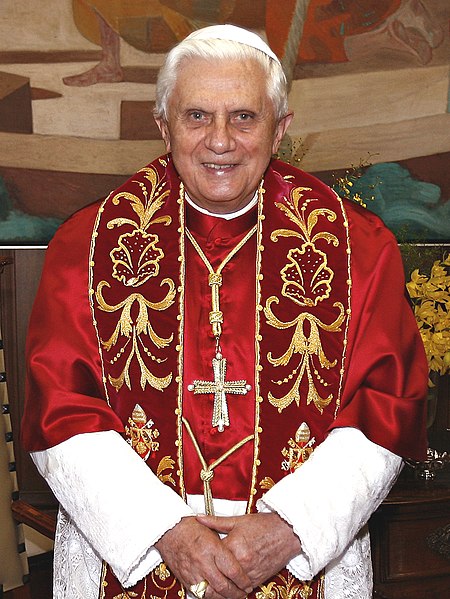
Santo Papa, si Benedicto XVI Ang Simbahang Katoliko Romano o Simbahang Katoliko (o Simbahang Katolika) ay isang Kristiyanong simbahan na nasa buong kapisanan kasabay ng Obispo ng Roma, na kasalukuyan ay ang Santo Papa, si Benedicto XVI. Binabakas ang pinagmulan nito sa orihinal na pamayanang Kristiyano na itinatag ni Hesus at ipinalaganap ng mga Labindalawang Apostol, partikular na si San Pedro. Ang Simbahang Katoliko ay ang pinakamalaking simbahang Kristiyano, na nagkakatawan sa kalahati ng lahat ng mga Kristiyano, at ay ang pinakamalaking organisadong yunit ng anumang pananampalataya sa mundo. Ayon sa Statistical Yearbook of the Church, ang bilang ng nakatalang pandaigdigang kasapi ng Simbahang Katoliko sa katapusan ng 2005 ay 1,114,966,000, na malapit sa ika-anim na bahagi ng populasyon ng mundo. Ang pandaigdigang Simbahang Katoliko ay binubuo ng isang Latin o Kanluranin at 22 Silanganing Katolikong nagsasariling simbahang partikular, kung saan lahat ay tumitingala sa Papa, na mag-isa o kasama ng Kolehiyo ng mga Obispo, bilang kanilang pinakamataas na autoridad sa daigdig sa mga paksa ng paniniwala, mga asal at ng pansimbahang pamamahala. Nakahati ito sa mga nasasakupang pook, karaniwan sa batayang teritoryal. Ang pamantayang teritoryal na yunit ay itinatawag na diyosesis sa simbahang Latin at eparkiya sa mga Silanganing simbahan. Ang bawat diyosesis o eparkiya ay nasa pamumuno ng isang obispo, patriyarka o eparko. Sa katapusan ng 2006, ang buong bilang ng lahat ng itong mga nasasakupang pook ay 2,782. Labels: THE PROFESSION OF FAITH |
| posted by Bro. Terence @ 6:03 AM |
|
|
|
| Salvation outside Catholic Church |
| Monday, March 23, 2009 |
The Catechism of the Catholic Church, following historic Christian theology since the time of the early Church Fathers, refers to the Catholic Church as "the universal sacrament of salvation" (CCC 774–776), and states: "The Church in this world is the sacrament of salvation, the sign and the instrument of the communion of God and men" (CCC 780).

Many people misunderstand the nature of this teaching.
Indifferentists, going to one extreme, claim that it makes no difference what church one belongs to. Certain radical traditionalists, going to the other extreme, claim that unless one is a full-fledged, baptized member of the Catholic Church, one will be damned.
The following quotations from the Church Fathers give the straight story. They show that the early Church held the same position on this as the contemporary Church does—that is, while it is normatively necessary to be a Catholic to be saved (see CCC 846; Vatican II, Lumen Gentium 14), there are exceptions, and it is possible in some circumstances for people to be saved who have not been fully initiated into the Catholic Church (CCC 847).
Notice that the same Fathers who declare the normative necessity of being Catholic also declare the possibility of salvation for some who are not Catholics.
These can be saved by what later came to be known as "baptism of blood" or " baptism of desire" (The Necessity of Baptism).
The Fathers likewise affirm the possibility of salvation for those who lived before Christ and who were not part of Israel, the Old Testament People of God.
However, for those who knowingly and deliberately (that is, not out of innocent ignorance) commit the sins of heresy (rejecting divinely revealed doctrine) or schism (separating from the Catholic Church and/or joining a schismatic church), no salvation would be possible until they repented and returned to live in Catholic unity.
'there are some people who will never, in any case, hear the name of Jesus and have the chance to be part of his Church. What about them?' On this point, the Catechism is very clear. "Those who, through no fault of their own, do not know the Gospel of Christ or his Church, but who nevertheless seek God with a sincere heart, and, moved by grace, try in their actions to do his will as they know it through the dictates of their conscience—those too may achieve eternal salvation." (CCC, 847) This is the notion of 'baptism by desire,' wherein a person is effectively baptized through their conformity with the natural law and, as the Catechism says, the "dictates of their conscience."Labels: THE PROFESSION OF FAITH |
| posted by Bro. Terence @ 8:12 PM |
|
|
|
| Homily of Pope Benedict XVI "MASS IN PIŁSUDZKI SQUARE Warsaw, 26 May 2006" |
|

“Stand firm in your faith!” We have just heard the words of Jesus: “If you love me, you will keep my commandments. And I will pray the Father, and he will give you another Counsellor, to be with you for ever, the Spirit of truth” (Jn 14:15-17a). With these words Jesus reveals the profound link between faith and the profession of Divine Truth, between faith and dedication to Jesus Christ in love, between faith and the practice of a life inspired by the commandments. All three dimensions of faith are the fruit of the action of the Holy Spirit. This action is manifested as an inner force that harmonizes the hearts of the disciples with the Heart of Christ and makes them capable of loving as he loved them. Hence faith is a gift, but at the same time it is a task.
“He will give you another Counsellor – the Spirit of truth.” Faith, as knowledge and profession of the truth about God and about man, “comes from what is heard, and what is heard comes by the preaching of Christ”, as Saint Paul says (Rom 10:17). Throughout the history of the Church, the Apostles preached the word of Christ, taking care to hand it on intact to their successors, who in their turn transmitted it to subsequent generations until our own day. Many preachers of the Gospel gave their lives specifically because of their faithfulness to the truth of the word of Christ. And so solicitude for the truth gave birth to the Church’s Tradition. As in past centuries, so also today there are people or groups who obscure this centuries-old Tradition, seeking to falsify the Word of Christ and to remove from the Gospel those truths which in their view are too uncomfortable for modern man. They try to give the impression that everything is relative: even the truths of faith would depend on the historical situation and on human evaluation. Yet the Church cannot silence the Spirit of Truth. The successors of the Apostles, together with the Pope, are responsible for the truth of the Gospel, and all Christians are called to share in this responsibility, accepting its authoritative indications. Every Christian is bound to confront his own convictions continually with the teachings of the Gospel and of the Church’s Tradition in the effort to remain faithful to the word of Christ, even when it is demanding and, humanly speaking, hard to understand. We must not yield to the temptation of relativism or of a subjectivist and selective interpretation of Sacred Scripture. Only the whole truth can open us to adherence to Christ, dead and risen for our salvation."Labels: THE PROFESSION OF FAITH |
| posted by Bro. Terence @ 8:06 PM |
|
|
|
| Rejecting God |
|
Many people fall away from the faith because they're angry at Him for a variety of reasons. We bring many of our problems upon ourselves by rejecting what God has planned for us!

Many extremely bad and sorrowful things happen to the best of people, and while we watch the innocent suffer, we must always remember one thing, and that one thing is that everything that is evil and unjust in this world is the result of sin, not God. Sin is man's disobedience to God. It is living outside of His will!
Don't be mad at God! Come home to Him!Labels: THE PROFESSION OF FAITH |
| posted by Bro. Terence @ 8:01 PM |
|
|
|
| Maria, Ina ng Diyos |
| Sunday, March 22, 2009 |

ika-8 Setyembre, ang kaarawan ni Maria na ating ina. Bilang paggunita sa minamahal nating "Mama," isang pagpapaliwanag ang ililimbag ng Pinoy Katoliko ukol sa titulo o katawagan kay Maria ng mga Katoliko na "Ina ng Diyos."
Hindi iba na magulat at kung minsan pa nga ay mangilabot ang ibang pananampalatayang Kristiyano sa pagtawag ng mga Katoliko kay Maria ng Ina ng Diyos. Tulad ng akdang ito ng isa pang Pinoy na blogger na nagsabing "God has not beginning nor end, therefore, He DOES NOT HAVE A MOTHER!" (Ang Diyos ay walang simula at hangganan, sumakatuwid WALA SIYANG INA!).
Ang ganitong mga reaksiyon ay nanggagaling sa hindi tamang pagkakaintindi ng ibang pananampalataya sa pundasyon ng gawaing Katoliko na ito. Inaakala ng iba na ating inilalagay si Maria bilang mas mataas sa Diyos--- ito ay malayo sa pananampalatayang Katoliko. Makakatulong kung tayo mismong mga Katoliko ay may malalim na pag-unawa sa ating pagmamahal kay Maria, upang mas mahusay natin itong maipaliwanag sa iba.
Ang Diyos ay Nagkatawang-tao
Tandaan ng ang mga Katoliko ay naniniwala sa inkarnasyon, o ang pagkakatawang-tao ng Diyos kay Hesus. Paano nasabi ng mga Katoliko na ang Panginoon ay nagkatawang-tao? Ilang bahagi ng Biblia ang nagpapatunay nito. Halimbawa, ninais ng mga Hudyo na patayin si Hesus dahil naiintindihan nila ang implikasyon ng Kanyang mga winiwika. "Dahil dito ay lalo ngang naghanap ng pagkakataon ang mga Judio na patayin siya. Ito ay sapagkat hindi lamang niya nilabag ang araw ng Sabat kundi tinawag pa niyang sariling Ama ang Diyos, na ipinapantay ang kaniyang sarili sa Diyos." Juan 5:18
Si San Tomas, matapos ang muling pagkabuhay, ay lubos na naunawaan ang implikasyon nito. "Sumagot si Tomas at sinabi sa kaniya: Aking Panginoon at aking Diyos." Juan 20:28.
Ito rin ay isang bagay na ipinaliwanag ni San Pablo sa unang mga Kristiyano. "Bagaman siya [Hesus] ay nasa anyong Diyos, hindi niya itinuring na kailangang pakahawakan ang kaniyang pagiging kapantay ng Diyos." Mga Taga-Filipos 2:6
Sapagkat iisa lamang ang Diyos, isang malaking kahangalan na tawagin ni Hesus ang Kanyang sarili bilang Diyos, o kaya ay kapantay ng Diyos. Ang tangi lamang paliwanag na hindi nag-sisinungaling si Hesus sa kanyang winika (at hindi niya nilinaw ang pananaw ng mga Hudyo, ni San Tomas o ni San Pablo) ay ang pagiging Diyos ni Hesus. Bagamat ito ay isang bagay na mahirap lubos na maunawaan ng isip ng tao, ito ay misteryong di imposible para sa Diyos---na ang Anak at Ama ay iisa.
Ang misteryo ng inkarnasyon ay nagsasabi sa atin ng isang mahalagang bagay: na si Hesus ay(1)totoong Diyos at (2)totoong tao.
Bakit ito kinailangan pang gawin ng Panginoon? Ang misteryong ito ay bukal ng ating pag-asa. Ang inkarnasyon ay isang larawan ng pag-ibig ng Diyos sa atin. Ang ating kasaysayan ng kaligtasan ay umiikot sa katotohanan na sa pagmamahal sa atin ng Diyos, inihandog Niya ang Kanyang nag-iisang Anak, upang iligtas ang sanlibutan. Sa katawan ng isang tao na nasasaktan at napapagod, dinala ng Panginoon ang kabayaran para sa lahat ng ating mga kasalanan. Minodelo ng Diyos mismo na Siya ay ang pinakadakilang pag-ibig. Isang pag-ibig na "Wala nang hihigit pa....na mag-alay ng kaniyang buhay para sa kaniyang mga kaibigan." Juan 15:13 (Maaaring basahin din ang akdang ito ng Pinoy Katoliko ukol sa pag-ibig ng Diyos.
Ang Pagiging Ina ni Hesus ni Maria
Kung si Hesus at totoong Diyos at totoong tao, saan nagmula ang Kanyang pagka-Diyos at pagka-tao?
Ang pagka-Diyos ni Hesus ay galing lamang sa Diyos Ama. Si Maria, tulad nating lahat ay isa lamang nilikha ng Panginoon, at alinsunod sa kagustuhan ng Ama. Tandaan na hinding-hindi sinasabi ng Katoliko na kay Maria nagmula ang pagiging Diyos! Hindi mas mataas si Maria sa Diyos, at kung mababasa ninyo ang Magnificat ni Maria (Lucas 1:46-55), malinaw na si Maria mismo ang nagsabi na siya'y isa lamang "alipin na nilingap ng Panginoon."
Ngunit ang pagkatao ni Hesus ay galing kay Maria. Siya ang nagsilang sa Kanya kasama ng Espiritu Santo. Bakit kailangan na dumaan pa sa isang tao si Hesus, bakit di na lang Siya basta isinugo? Sapagkat ang Panginoon ay nagnais magkatawang-tao, at si Maria ang nagbigay sa Kanya ng Kanyang laman.
Hindi lang biolohikal ang pagka-ina ni Maria kay Hesus kung hindi sa puso na rin. Hindi ba't si Maria ang nagpalaki kay Hesus kasama si San Jose, ang nagturo kay Hesus magsalita at lumakad, ang umiyak kasama Niya sa kapalaran ni Hesus?
Kung Si Hesus ay totoong Diyos at si Maria ay totoong ina ni Hesus, hindi ba marapat lamang na tawagin si Maria na Ina ng Diyos?
May ibang nagsasabi na bakit hindi na lang linawin na si Maria ay ina lamng ng tao na Hesus at di ng Hesus na Diyos? Maganda ang kasagutan ni James Cardinal Gibbons, dating Arsobispo ng Baltimore, sa kanyang aklat na "The Faith of Our Fathers" (Ang Pananampalataya ng ating mga Ama). Ginamit ni Arsobispo Gibbons ang ating relasyon sa ating sariling ina upang linawin ang konsepto na pagkaganap ng pagiging isang ina. Sinabi niya na na hindi naman natural na ipinaghihiwalay ang ina ng ating katawan at ng ating kaluluwa. Bagamat ang ating kaluluwa ay galing sa Diyos---at ang ating katawan lamang ang mula sa ating mga ina, hindi natin ipinagkakait sa ating ina ang kaganapan ng kanyang pagka-ina. Kung gayon, bakit natin ipagkakait kay Maria ang kanyang pagka-ina ni Hesus?
Tamang Pagka-unawa
Hinihikayat ang lahat sa tamang pag-unawa ng turo at gawi na ito ng Iglesia Katolika. Sabi nga ng Katesismo para sa mga Pilipinong Katoliko ang "Santa Maria, Ina ng Diyos" sa Aba Ginoong Maria ay nagpapatunay "na hindi isang "diyos" si Maria, kung hindi ang kanyang Anak ay Tunay na Diyos."(CBCP 2000,520),
Labels: THE PROFESSION OF FAITH |
| posted by Bro. Terence @ 8:16 PM |
|
|
|
| Si Hesus ay Tunay na Diyos at Tunay na Tao |
|
Ang Simbahang Katoliko ay naniniwala sa doktrina ng Inkarnasyon o ang turo na si Hesus ay 'tunay na Diyos at tunay na tao'. Bagamat madali itong sabihin, tulad ng maraming bagay sa ating buhay-pananampalataya, naglalaman ito ng isang napakalalim na misteryo. Ang Inkarnasyon ay nagsasalamin ng hindi lamang kalikasan ng Diyos, kung hindi nagsasalaysay din ito ng kasaysayan ng ating kaligtasan. Mainam na tayo ay palagiang magnilay ukol sa Inkarnasyon at kung ano ang implikasyon nito sa ating pang-araw-araw na buhay.
Ano ba ang Inkarnasyon (o mas kilala sa Tagalog na 'Pagkakatawang tao')?
Ayon sa simbahan, ang Inkarnasyon ay ang pagpapatotoo ng ang Salita ay naging isang tunay na tao. Ang Diyos Ama ay nakiisa sa sangkatauhan may 2,000 tao na nakakaraan at naglakad sa ating daigdig sa katauhan ni Hesu-Kristo. Ginawa Niya ito upang (a) maligtas tayo sa pagkaalipin sa ating mga kasalanan, (b) upang ipahayag sa atin ang walang-maliw na pagmamahal ng Diyos, (k) upang maging huwaran natin bilang Daan, Katotohanan at Buhay at (d) ibahagi sa atin ang kanyang pagiging Banal na Anak (CBCP, Katesismo para sa mga Pilipinong Katoliko 533).
Tandaan na ang pagka-Diyos at pagka-tao ni Hesus ay hindi dalawang hiwalay na kalikasan, kung saan minsan ay Diyos si Hesus, minsan naman Siya ay tao. Kung hindi, ang lahat-lahat ng kilos ni Hesus ay sabay na gawain ng Diyos at gawain ng isang tao. Hindi Siya Diyos na nagpapanggap na isang tao; Siya ay tunay na nagutom, nasaktan at nakaramdam ng iba'-ibang damdamin noong Siya ay nabubuhay sa mundo---tulad din nating lahat. Hindi rin Siya tao na sinusubaybayan lang ng Diyos tulad ng turo ng ibang mga sektang Kristiyano. Sa Kanyang sarili ang perpektong ugnayan ng kalikasang Diyos at Tao.
Ang Kalikasang Diyos ni Hesus
Sa Lumang Tipan pa lamang makikita na natin na nasa plano ng Ama ang pagka-Diyos ni Hesus. Sinabi ng propetang si Isaias: "Ang Diyos mismo ang darating at magliligtas sa inyo" (Isaias 35:4). Sinabi ni Isaias na ang Mesiyas o ang takdang Tagapagligtas ay magngangalang "Emmanuel" na nangangahulugang "Ang Diyos ay Kapiling Natin." Tinawag din ni Isaias ang Mesiyas na 'isang makapangyarihang (o malakas sa ibang pagsasali) Diyos.' ( Isaias 9:6). Ang Ebanghelyo ni Mateo (Mateo 1:23) ang nag-ugnay na si Hesus nga ang tinakdang Tagapagligtas na ito.
Ang Bagong Tipan ay siksik sa mga akda na nagtuturo sa kalikasang Diyos ni Hesus. Kung tutuusin nga, kaya hindi matanggap ng mga Hudyo noon (at ngayon!) si Hesus ay dahil nagbitiw Siya ng mga pananalita at pagkilos na tanging Diyos lamang ang may karapatang at kakayahan na magsabi o magsagawa. Siya ay nagpatawad ng mga kasalanan, nagsagawa ng milagro, nagtakwil ng demonyo, at nangaral ng may awtoridad ng Diyos. Binago Niya interpretasyon ng karamihan ng mga batas na sinusunod ng mga Hudyo, mga batas na galing mismo sa Diyos! Ilang ulit Niyang sinabi "Sundan niyo ako." Hindi "Ako'y mensahero lamang" kung hindi "Sundan niyo ako." Aba't sobrang mapangahas naman ng taong ito na gawin ang mga bagay na tanging Diyos lang ang dapat gumawa! Ngunit katanggap-tanggap ito sapagkat Siya na nga ang Diyos.

May ilang ulit sa Ebanghelyo na ginamit ni Hesus ang katagang "Mesiyas" at "Anak ng Diyos" bilang pagtukoy sa Kanyang Sarili. Ginawa niya ito sa kabila ng katotohanan na sa ituinuturing na napakalaking kahangalan ang paggamit ng ganitong pananalita. Kung titingnan nga ay baka hindi naipako si Hesus kung sasabihin lamang Niya na hindi Siya ang tunay na Mesiyas. Ngunit ito ay kanyang pinanghawakan sa kabila ng posibleng kamatayan.
Ang kaganapan sa Juan 10:23-35 ay isang napakatingkad na ilustrasyon ng bagay na ito:
"Naganap sa Jerusalem ang kapistahan ng pagtatalaga. Noon ay taglamig. Si Jesus ay naglalakad sa templo sa portiko ni Solomon. Pinalibutan nga siya ng mga Judio. Sinabi nila sa kaniya: Hanggang kailan mo paghihintayin ang aming kaluluwa? Kung ikaw ang Mesiyas, sabihin mo sa amin nang tuwiran.
Sumagot si Jesus sa kanila: Sinabi ko na sa inyo ngunit hindi kayo sumampalataya. Ang mga gawang ginagawa ko sa pangalan ng aking Ama ang siyang nagpapatotoo sa akin. Hindi kayo sumasampalataya sapagkat hindi kayo kabilang sa aking mga tupa gaya ng sinabi ko sa inyo. Dinirinig ng aking mga tupa ang aking tinig. Kilala ko sila at sumusunod sila sa akin. Binibigyan ko sila ng buhay na walang hanggan. Hindi sila malilipol magpakailanman. Walang sinumang makakaagaw sa kanila sa aking kamay. Ibinigay sila sa akin ng aking Ama. Siya ay higit na dakila sa lahat. Walang makakaagaw sa kanila mula sa kamay ng aking Ama. Ako at ang Ama ay iisa.
Muli ngang dumampot ng mga bato ang mga Judio upang siya ay batuhin. Sinabi sa kanila ni Jesus: Maraming mabubuting gawa ang ipinakita ko sa inyo mula sa aking Ama. Alin sa mga gawang iyon ang dahilan para batuhin ninyo ako?
Sumagot ang mga Judio sa kaniya na sinasabi: Hindi ka namin binabato dahil sa anumang mabuting gawa kundi dahil sa iyong pamumusong. Ginagawa mong Diyos ang sarili mo, ikaw na isang tao."
Mababasa din sa Mateo 62-65 na pinangatawanan ni Hesus sa Kanyang tunay na kalikasan hanggang sa panahon ng posibleng kamatayan:
"Tumayo ang pinakapunong-saserdote at sinabi sa kaniya: Wala ka bang isasagot? Ano itong ipinaparatang ng mga saksing ito laban sa iyo? Ngunit si Jesus ay nanahimik.
Sinabi ng pinakapunong-saserdote sa kaniya: Inuutusan kita sa pamamagitan ng buhay na Diyos. Sabihin mo sa amin kung ikaw ang Mesiyas, ang Anak ng Diyos?
Sinabi ni Jesus sa kaniya: Tama ang iyong sinabi. Gayunman, sinasabi ko sa iyo: Mula ngayon ay makikita mo ang Anak ng Tao na nakaupo, siya ay makikita mo sa kanang kamay ng Makapangyarihan at dumarating sa mga ulap ng langit.
Nilibak ng mga Kawal si Jesus. Pinunit ng pinakapunong-saserdote ang kaniyang damit. Sinabi niya: Siya ay namusong. Bakit kailangan pa natin ang mga saksi? Narito, narinig ninyo ang kaniyang pamumusong. Ano ang palagay ninyo?
Sumagot sila: Siya ay nararapat na mamatay!"
Sinabi ni Hesus sa harap ng maraming tao na Siya nga ang Mesiyas. Makikita na para sa mga Hudyo noong panahon na iyon, ang pag-amin na Siya ang Mesiyas ay nangangahulugan na sinasabi Ni Hesus na Siya ay Diyos. Kung sinasabi lamang Niya na Siya ay isang propeta, bakit magagalit ang punong-saserdote? Marami na namang propeta ang dumaan sa kasaysayan ng mga Hudyo. May sinasabi si Hesus na lubhang nakaka-iskandalo sa mga tao noong panahon na iyon, at ito nga na Siya ay higit sa ordinaryong mamamayan. Ang bagay na ito ay pinangatawanan din ng unang Iglesia, ayon sa testimonya ni San Pablo na binigyan mismo ng Panginoon ng kaalaman ukol sa Kanya. Ang ilang mga sulat ni Pablo ay nagpapatotoo dito, tulad ng mga sumusunod: Sulat sa mga Taga-Filipos 2:5-8 "Ito ay sapagkat kailangang taglayin ninyo ang kaisipan na na kay Cristo Jesus din naman. Bagaman siya ay nasa anyong Diyos, hindi niya itinuring na kailangang pakahawakan ang kaniyang pagiging kapantay ng Diyos. Bagkus ginawa niyang walang kabuluhan ang kaniyang sarili at tinanggap niya ang anyo ng isang alipin at nakitulad sa tao. 8Yamang siya ay nasumpungan sa anyong tao, siya ay nagpakumbaba at naging masunurin hanggang sa kamatayan, maging sa kamatayan sa krus."Sulat sa mga Taga-Colosas 2:9 "Ito ay sapagkat nananahan sa kaniyang katawan ang lahat ng kapuspusan ng kalikasan ng Diyos."Sulat sa mga Taga-Colosas 1:16 "Ito ay sapagkat sa pamamagitan niya, nilalang ang lahat ng mga bagay na nasa langit at mga bagay na nasa lupa, mga bagay na nakikita o hindi nakikita. Ito man ay mga luklukan, o mga paghahari, o mga pamunuan, o mga pamamahala. Ang lahat ng bagay ay nilalang sa pamamagitan niya at para sa kaniya." Labels: THE PROFESSION OF FAITH |
| posted by Bro. Terence @ 8:14 PM |
|
|
|
| God to Be Esteemed Above All Else, Because He is Unchangeable Wisdom. by saint Augustine |
| Monday, March 16, 2009 |
And since all who think about God think of Him as living, they only can form any conception of Him that is not absurd and unworthy who think of Him as life itself; and, whatever may be the bodily form that has suggested itself to them, recognize that it is by life it lives or does not live, and prefer what is living to what is dead; who understand that the living bodily form itself, however it may outshine all others in splendor, overtop them in size, and excel them in beauty, is quite a distinct thing from the life by which it is quickened; and who look upon the life as incomparably superior in dignity and worth to the mass which is quickened and animated by it.
Then, when they go on to look into the nature of the life itself, if they find it mere nutritive life, without sensibility, such as that of plants, they consider it inferior to sentient life, such as that of cattle; and above this, again, they place intelligent life, such as that of men. And, perceiving that even this is subject to change, they are compelled to place above it, again, that unchangeable life which is not at one time foolish, at another time wise, but on the contrary is wisdom itself. For a wise intelligence, that is, one that has attained to wisdom, was, previous to its attaining wisdom, unwise. But wisdom itself never was unwise, and never can become so. And if men never caught sight of this wisdom, they could never with entire confidence prefer a life which is unchangeably wise to one that is subject to change. This will be evident, if we consider that the very rule of truth by which they affirm the unchangeable life to be the more excellent, is itself unchangeable: and they cannot find such a rule, except by going beyond their own nature; for they find nothing in themselves that is not subject to change.Labels: THE PROFESSION OF FAITH |
| posted by Bro. Terence @ 2:38 AM |
|
|
|
| What All Men Understand by the Term God. Saint Augustine |
|
For when the one supreme God of gods is thought of, even by those who believe that there are other gods, and who call them by that name, and worship them as gods, their thought takes the form of an endeavor to reach the conception of a nature, than which nothing more excellent or more exalted exists. And since men are moved by different kinds of pleasures, partly by those which pertain to the bodily senses, partly by those which pertain to the intellect and soul, those of them who are in bondage to sense think that either the heavens, or what appears to be most brilliant in the heavens, or the universe itself, is God of gods: or if they try to get beyond the universe, they picture to themselves something of dazzling brightness, and think of it vaguely as infinite, or of the most beautiful form conceivable; or they represent it in the form of the human body, if they think that superior to all others.

Or if they think that there is no one God supreme above the rest, but that there are many or even innumerable gods of equal rank, still these too they conceive as possessed of shape and form, according to what each man thinks the pattern of excellence. Those, on the other hand, who endeavor by an effort of the intelligence to reach a conception of God, place Him above all visible and bodily natures, and even above all intelligent and spiritual natures that are subject to change. All, however, strive emulously to exalt the excellence of God: nor could any one be found to believe that any being to whom there exists a superior is God. And so all concur in believing that God is that which excels in dignity all other objects.Labels: THE PROFESSION OF FAITH |
| posted by Bro. Terence @ 2:37 AM |
|
|
|
| Reasons for Burying the Bodies of the Saints. Saint Augustine |
|
Nevertheless the bodies of the dead are not on this account to be despised and left unburied; least of all the bodies of the righteous and faithful, which have been used by the Holy Spirit as His organs and instruments for all good works. For if the dress of a father, or his ring, or anything he wore, be precious to his children, in proportion to the love they bore him, with how much more reason ought we to care for the bodies of those we love, which they wore far more closely and intimately than any clothing! For the body is not an extraneous ornament or aid, but a part of man’s very nature. And therefore to the righteous of ancient times the last offices were piously rendered, and sepulchres provided for them, and obsequies celebrated; and they themselves, while yet alive, gave commandment to their sons about the burial, and, on occasion, even about the removal of their bodies to some favorite place. And Tobit, according to the angel’s testimony, is commended, and is said to have pleased God by burying the dead. Our Lord Himself, too, though He was to rise again the third day, applauds, and commends to our applause, the good work of the religious woman who poured precious ointment over His limbs, and did it against His burial. And the Gospel speaks with commendation of those who were careful to take down His body from the cross, and wrap it lovingly in costly cerements, and see to its burial. These instances certainly do not prove that corpses have any feeling; but they show that God’s providence extends even to the bodies of the dead, and that such pious offices are pleasing to Him, as cherishing faith in the resurrection. And we may also draw from them this wholesome lesson, that if God does not forget even any kind office which loving care pays to the unconscious dead, much more does He reward the charity we exercise towards the living.

Other things, indeed, which the holy patriarchs said of the burial and removal of their bodies, they meant to be taken in a prophetic sense; but of these we need not here speak at large, what we have already said being sufficient. But if the want of those things which are necessary for the support of the living, as food and clothing, though painful and trying, does not break down the fortitude and virtuous endurance of good men, nor eradicate piety from their souls, but rather renders it more fruitful, how much less can the absence of the funeral, and of the other customary attentions paid to the dead, render those wretched who are already reposing in the hidden abodes of the blessed! Consequently, though in the sack of Rome and of other towns the dead bodies of the Christians were deprived of these last offices, this is neither the fault of the living, for they could not render them; nor an infliction to the dead, for they cannot feel the loss.Labels: THE PROFESSION OF FAITH |
| posted by Bro. Terence @ 2:32 AM |
|
|
|
| If Adam Had Not Sinned, He Would Never Have Died. By Saint Augustine |
|
They who say that Adam was so formed that he would even without any demerit of sin have died, not as the penalty of sin, but from the necessity of his being, endeavour indeed to refer that passage in the law, which says: “On the day ye eat thereof ye shall surely die,”
   

not to the death of the body, but to that death of the soul which takes place in sin. It is the unbelievers who have died this death, to whom the Lord pointed when He said, “Let the dead bury their dead.” Now what will be their answer, when we read that God, when reproving and sentencing the first man after his sin, said to him, “Dust thou art, and unto dust shalt thou return?” For it was not in respect of his soul that he was “dust,” but clearly by reason of his body, and it was by the death of the self-same body that he was destined to “return to dust.” Still, although it was by reason of his body that he was dust, and although he bare about the natural body in which he was created, he would, if he had not sinned, have been changed into a spiritual body, and would have passed into the incorruptible state, which is promised to the faithful and the saints, without the peril of death. And for this issue we not only are conscious in ourselves of having an earnest desire, but we learn it from the apostle’s intimation, when he says: “For in this we groan, longing to be clothed upon with our habitation which is from heaven; if so be that being clothed we shall not be found naked. For we that are in this tabernacle do groan, being burdened; not for that we would be unclothed, but clothed upon, that mortality may be swallowed up of life.” Therefore, if Adam had not sinned, he would not have been divested of his body, but would have been clothed upon with immortality and incorruption, that “mortality might have been swallowed up of life;” that is, that he might have passed from the natural body into the spiritual body.Labels: THE PROFESSION OF FAITH |
| posted by Bro. Terence @ 2:04 AM |
|
|
|
| Who is Jesus? |
|
Jesus Christ, Being the Only Son of God, is at the Same Time Man.

Wherefore Christ Jesus, the Son of God, is both God and man; God before all worlds; man in our world: God, because the Word of God (for “the Word was God”); and man, because in His one person the Word was joined with a body and a rational soul. Wherefore, so far as He is God, He and the Father are one; so far as He is man, the Father is greater than He. For when He was the only Son of God, not by grace, but by nature, that He might be also full of grace, He became the Son of man; and He Himself unites both natures in His own identity, and both natures constitute one Christ; because, “being in the form of God, He thought it not robbery to be,” what He was by nature, “equal with God.” But He made Himself of no reputation, and took upon Himself the form of a servant, not losing or lessening the form of God. And, accordingly, He was both made less and remained equal, being both in one, as has been said: but He was one of these as Word, and the other as man. As Word, He is equal with the Father; as man, less than the Father. One Son of God, and at the same time Son of man; one Son of man, and at the same time Son of God; not two Sons of God, God and man, but one Son of God: God without beginning; man with a beginning, our Lord Jesus Christ. Labels: THE PROFESSION OF FAITH |
| posted by Bro. Terence @ 1:49 AM |
|
|
|
|
| About Me |
|

Name: Bro. Terence
Home: Sta. Maria, Bulacan, Philippines
About Me: pogi?
See my complete profile
|
| Previous Post |
|
| Archives |
|
|
| Catholic Blog By the
Priest and Deacon |
|
Ad Maiorem Dei Gloriam - Fr.
Patrick Fairbanks, SJ
Adam's Ale - Fr. Valencheck,
Ohio
Amigos de Banica - Fr. O'Hare
Anamchara - Msgr. Eric R. Barr,
Illinois
AtonementOnline - Fr. Christopher
G. Phillips, Texas
Bangor to Bobbio - Fr. Seán
Coyle, Philippines
Bear Witness to the Light - Fr.
John L., Massachusetts
A Beggar for Love - Fr. Daren J.
Zehnle, Illinois
Being is Good - Deacon Dana,
Florida
Bekeh's Blog - Fr. Bekeh
Utietiang
Bekeh's Homilies - Fr. Bekeh
Utietiang
Bishop William Lori's Blog -
Bishop William Lori, Connecticut
The Black Biretta - Padre
Giovanni, Pennsylvania
Blessed is the Kingdom - Fr.
Christian Mathis, Tennessee
Blog do Padre Luizinho - Fr.
Luizinho, Brazil
Blog do Padre Roger Luis - Fr.
Roger Luis, Brazil
Blog of Fr. Peter Leung - Fr.
Peter Leung
Bonfire of the Vanities - Fr.
Martin Fox, Ohio
Breaking the Word - Fr. Chris
The Bridge - Fr. Frank Majka, SJ,
Wisconsin
Byzantine Ramblings - The
Byzantine Rambler
Called by Name - Fr. Kyle
Schnippel, Ohio
Cardinal Seán's Blog - Seán
Cardinal O'Malley, Massachusetts
Caritas Christi Urget Nos - Fr.
Pat Mulcahy, Illinois
A Cascade Catholic - Deacon Al
Ardon, Washington
Catholic Spiritual Direction -
Fr. John Bartunek, LC, New York
Catholic Under the Hood - Fr.
Seraphim Beshoner
Catholic Vision - Fr. Andrew,
South Dakota
Catholicism, Scholarship &
Fun - Fr. James Lloyd, CSP, New York
Catholikos Diakonos - Deacon
Scott Dodge, Utah
CFR Sudan Mission - Fr. Herald
Joseph Brock, CFR, Sudan
Claretian Teaching Ministry - Fr.
John Hampsch, CMF, California
Clerical Whispers - Sotto Voce,
Ireland
Communio ~ Fr. Richard Healey -
Fr. Richard Healey, Australia
A Concord Pastor Comments -
ConcordPastor, Massachusetts
Confessionário dum Padre -
Confessional, Portugal
CSVF Blog - Fr. Aquinas, OP, New
York
CUSA Blog - Fr. Lawrence
Jagdfeld, OFM
Da Mihi Animas - Padre Steve, New
Jersey
De Fide Catholica - Fr. Laurent
Demets, Arkansas
Deacon Dan Wright - Dan Wright,
Texas
Deacon Tom Stonecipher - Tom
Stonecipher, Georgia
Deacon Tony's Place - Deacon
Tony, New York
The Deacon's Bench - Deacon Greg
Kandra, New York
Deacon's Diary - Group
Deo Adiuvante - Fr. Leo McDowell,
Montana
Diakonia - Deacon Patrick Kearns,
California
Diario de Fray Nelson M. - Fr.
Nelson Medina, Columbia
Diary of a Pilgrimage - Deacon
Shawn Tunink, Illinois
Diary of a Rookie Priest - Fr.
Mark Mossa, SJ
Discalced Carmelite Friars - Fr.
Adam
Do Whatever He Tells You - Fr.
Mitchell Zimmerman, Kansas
Dom Donald's Blog - Dom Donald,
Scotland
Domine, da mihi hanc aquam! - Fr.
Philip Powell, O.P. , Texas
Dominican History - Fr. John
Frederick Hinnebusch, OP & Fr. Stephen Ryan, OP
Dominican Liturgy - Fr. Augustine
Thompson, OP, Virginia
DominicanSingapore - Fr.
David
Douloscross Web Journal - Deacon
Harry Martin, California
Eloi's Voice - Fr. Rich
Brensinger, Pennsylvania
Evening Devotions - Fr. Scott
Bailey, C.SS.R., Massachusetts
Eyes of Faith - Fr. Larry
Gearhart, Ohio
Father Anthony Ho - Fr. Anthony
Ho, Canada
Father Bill Dinga's Blog - Father
Bill Dinga
Father Dennis - Fr. Dennis,
Iowa
Father Dylan's Sermons - Fr.
Dylan James, England
Father Jim Chern's Blog - Fr. Jim
Chern, New Jersey
Father Joe - Fr. Joe,
Maryland
Father Ray's 'Other' Corner - Fr.
Ray Suriani
Father Sullivan - Fr. Thomas
Sullivan, Florida
A Few Simple Words - Fr. Bob,
Washington, DC
Fiat Volvntas Tua - Fr. Joe,
Philippines
Fire, Salt, and Light - Arthur
Joseph, Canada
Followers of the Way - Deacon
Jacob Maurer
Forest Murmurs - Fr. Michael
Brown, UK
Fortuna's Fortune - Fr. Stan
Fortuna
Fr. Bob's Corner - Fr. Bob
MacDonald, Canada
Fr. Bosco Galli - Fr. Bosco
Galli, UK
Fr. Brendan - Fr. Brendan Manson,
California
Fr. Carmen Mele, Dominican
Preacher - Fr. Carmen Mele, Texas
Fr. H. Paul - Fr. H. Paul Kim,
Ohio
Fr. JC Maximilian's Homilies & Spiritual
Reflections - Fr. JC Maximilian, New Jersey
Fr. Mildew - Fr. Michael Clifton,
UK
Fr. Victor Brown's Catholic Daily
Message - Fr. Victor Brown
Fr. West's Catholic Blog - Fr.
Peter West, New York
Fred's Place - Fr. Ed Burns, Ohio
FRIARside Chats - Fr. Chuck
Talley, OFM, California
Friends with Christ - Fr. Richard
Aladics & Fr. Julian Green, UK
Gloria Olivae - Fr. Odon de
Castro, Philippines
God's Word to Us - Fr. Dominic
Canh Tran, SDB
Gone Walkabout - Fr. Jim
McDermott, SJ, Australia
The Great Commandment - Fr. David
Hudgens, Michigan
|
The Hermeneutic of
Continuity - Fr. Tim Finigan, England
Hills of the North, Rejoice
- Deacon Peter Simpson, Scotland (formerly The Deacon of
Ham) Holy Priesthood - Fr. Joel
& Fr. Benjamin
Homilies and Reflections from
Australia - Fr. John Speekman,
Australia
Homilies of a Jesuit - The
Jesuit
How Can I Keep from
Singing? - Fr. Ernie Davis,
Missouri
Husband, Father, Deacon,
Man - Deacon Patrick, Colorado
I Am Not Ashamed of the
Gospel - Deacon Steve, Michigan
I Love You! - Deacon
Randy
In and Out of Season -
Archbishop Angel Lagdameo, Philippines
Jamesaubrey - JamesAubrey,
Oklahoma
Jesus Goes to Disney World
- Fr. Austin Murphy, Maryland Journal of God's Call - Fr.
Christopher Rossman, Kansas
Kingmancatholic - Fr. James
Weldon, Kansas
Laus Crucis - Fr. Paul
Francis Spencer, CP, Scotland
Life's Crosses- Fr.
Aloysius Ong, Singapore
Living Sacrifice - Fr.
Christopher M. Mahar, Rhode Island
Lux Vera - Fr. David
Thoroughgood, Australia
Mary, Our Mother - Totus
Tuus and RomanCatholic Deacon
Mary's Anawim - Fr. Rick
Heilman, Wisconsin
Me Monk. Me Meander - Fr.
Stephanos, OSB
Mercy and Mary - Fr. John
Larson, Washington D.C.
A Minor Friar - Friar
Minor
Misericórdia e Verdade -
Padre Reinaldo, Brazil
The Monastic Preacher -
Prior Peter, OSB
Monks and Mermaids - Fr.
David Bird, OSB, Peru
Monk's News - Fr. Kenneth,
OSB, Missouri
My World - Fr. Phil, New
Hampshire
Oasis of Peace: Mission to
Iraq - MCITL: Meeting Christ in the
Liturgy, Iraq
Omne Quod Spirat, Laudet
Dominum! - Fr. Cory Sticha, Montana
One Monk of the Order of St.
Benedict - Fr. Stephanos, OSB
Orthometer - Fr. Erik
Richtsteig, Utah
Overheard in the Sacristy -
Fr. L.W. Gonzales, Arizona
Owl of the Remove - The Owl
of the Remove, Vermont
Padre Antonio Aguiar - Fr.
Antonio Aguiar, Brazil
Padre Cleidimar - Fr.
Cleidimar Moreira, Brazil
Pan de la Semana - Fr.
Vitaliano Chito Dimaranan, SDB, Philippines
Parish the Thought - Fr.
Bud Pelletier, Arizona
Per Agrum Ad Sacrum - Fr.
Vitaliano Chito Dimaranan, SDB, Philippines
Peregrinus - Pilgrim On,
California
Prayer on the Hill - Fr.
Milton E. Jordan, Washington, DC
Priest - Fr. Jessie
Somosierra, Jr., Philippines
A Priestly Commentary - Fr.
V, Massachusetts
Printed as Preached - Fr.
Cávana Wallace, California
Prior's Blog - Prior Peter,
OSB, Illinois
Prophetic Fraternal
Franciscan - Fr. Kim Studwell, OFM,
Wisconsin
Quod Scripsit - Eques
Rationabile Obsequium -
FrB
Rev Fr. Bosco's Space - Fr.
Bosco, UK
RevRobJack.com - Fr. Rob
Jack, Ohio
Rifugio San Gaspare - Fr.
Jeffrey Keyes C.PP.S., California
Roman Miscellany - Fr.
Nicholas Schofield, England
The Sacred Congregation of
Rites - Scranton Priest
Scriptural Reflections -
Fr. Bert, SM
Seek His Face - Fr. Ronald
Check, Pennsylvania
Servant and Steward - Fr.
Daren Zehnle, Illinois
A Shepherd's Voice - Fr.
John Molloy, California
Shouts in the Piazza - Guy
Sylvester, New Jersey
The Speakin' Deacon -
Deacon John, Kentucky
Spes Unica - Fr. Stephen,
CSC
Spiritual Friendship - Fr.
Antonio, Lebanon
The Splendor of the Church
- Fr. Abe, CRS, Philippines
St. Andrew Q&A - Fr.
Greg
St. Marie's Gem - Fr.
Francis Wadsworth
St. Mary Magdalen, Brighton,
UK - Fr. Ray Blake, UK
St. Michael's Cyber Parish
- Fr. James Proffitt, Maryland
St. Vincent Archabbey
Vocations - Fr. Fred Byrne, OSB,
Pennsylvania
Standing on my Head - Fr.
Dwight Longenecker, South Carolina
The Sunday Homily - Fr.
James Farfaglia, Texas
There is an Appointed Time for
Everything... - Fr. James Willard
Northrop, Washington
Thoughts from the Lune
Valley - Fr. Paul Harrison, UK
Thrown Back - Fr. Rob
Johansen, Michigan
Thy Nose to the Marble -
Fr. Christopher Decker
To Find Fruit - Paul D.
Panaretos, SJ, Ohio
The Truth Will Make You Free
- Fr. Robert Connor, New York
Two Edge Talk - Deacon Tim
& Cyndi
The Ultramontanist - Padre
Paulus, Washington, DC
viewpoints - Archbishop
Oscar Cruz, Philippines
Virtual Retreat - Fr. Rory
Pitstick, SSL, Washington
Vita Mea - Fr. Dennis,
Indiana
Vocations Views - Fr. Todd
J. Petersen, Minnesota
Vultus Christi - Fr. Mark
Daniel Kirby, O.Cist.
weCatholic.org - Deacon
Patrick, Colorado
What Does the Prayer Really
Say? - Fr. John Zuhlsdorf
White Around the Collar -
Fr. Dana Christensen, South Dakota
Word Incarnate - Abbot
Joseph, California
Young Fogeys - Fr. Jay
Toborowsky, New Jersey
2000 Stories - Fr. Thomas
Dowd, Canada (formerly Waiting in Joyful
Hope)
21st Century Catholic -
Deacon Jacob Maurer,
Washington |
|
| Catholic Blog By the Lay
and Religious |
|
Ad Saeculum - Br. Robert, OP
Air
Maria - Franciscan Friars of the Immaculate,
Connecticut
All Roads Lead to Rome! - Br.
Tom, New York
An Ambassador for Christ - Br.
Christopher Gaffrey, Italy
Amy Hereford, CSJ - Amy Hereford,
CSJ, Belgium
Anchorhold for Jesus: Ireland - A
Nun, Ireland
BayaThread - Baya Clare, CSJ,
Minnesota
Best Catholic Books - Sr. Julia,
Louisiana
Bloggin' Friar at franciscans.org
- Friar Matt
Blogging Brother Brian - Br.
Brian, Texas
Br. Michael-Godfrey's Prayer -
Br. Michael-Godfrey
Bukas Palad - Adrian Danker, SJ,
Philippines
Caritas Christi Urget Nos! - Sr.
Cora
Carmelitana - Paul Chandler,
Italy
Carmelite Sisters
Caught Up in God
Chronicles of the Daily Grind -
Brodiz, Philippines
Cistercian Vocation - Sr.
Eleanor, Ireland
The City and the World - Joe
Koczera, SJ, New York
Colophon: A Monastery Blog - Holy
Trinity Monastery, UK
Contemplative Horizon -
Contemplative Woman
Crux of the Matter - Amy L.
Cavender, CSC, Indiana
Colwich Novitiate - Noviceship,
England
Crying Out in the Wilderness -
Richard Beebe, SJ, Michigan
CSJ Novitiate - Group
Day by Day - Sr. Lynn,
Missouri
Deo Gratia - Nader's Blog - Nader
Ata, Texas
The Digital Nun - Sister Judy
Connor, CDP
Discover God in the Everyday. With
us. - Ferdinand Benedictines, Indiana
Dominican Cooperator Brother -
Br. Paul, OP, Missouri
Dominican Sisters of Blauvelt -
Dominican Sisters, New York
Franciscan Footprints - Sr.
Veronica
Franciscan Life - Sr. Ann Marie,
Pennsylvania
Franciscan Musings - Rashfriar,
Washington, DC
Franciscan Sisters of Christian
Charity - Group
A Friar Style? - Freddie
From Marbury's Hilltop - St. Jude
Monastery, Alabama
Happynun Thinks Aloud -
Happynun
Hell Burns - Sr. Helena Burns,
Chicago
Hope-Full Signs - Sr. Judith, New
Jersey
IHM
Calling - Sister Mary Bea, Michigan
In the Shadow of His Wings -
Passionist Nuns, Kentucky
The Itinerant's Path - Br.
Vincent J. Celeste, FMS, Philippines
A Jesuit's Journey - Ryan Duns,
SJ
The Journey - Sr. Paulina Quinn,
OP
Kicking and Screaming - Tom
Gibbons, CSP
La Paz de Susan - Susan Dewitt,
CSJP, Washington
The Last Brother? Not if I Can Help
It! - Br. James Hayes, England
Life at the Convent - Sr. Mary
Lou, Minnesota
Life at the Monastery of St.
Gertrude
The Life of a New Sister - Sr.
Nicole Trahan, Texas
Life on Lotus Lane - Dominican
Nuns, Texas
Light through Stained-Glass
Windows - Susan Doubet, OSB
Little Portion Hermitage - Friar
Rex, Maine
Live Jesus! - a Visitation Nun,
Washington D. C.
Living the Zeal of Benedict -
Marilyn Schauble, OSB, Pennsylvania
Meg Funk - Sr. Meg Funk,
Indiana
Monastery Podcast - Benedictine
Sisters of Perpetual Adoration
Monastic Moments - Sr. Patricia,
Washington
Monastic Musings - Edith, OSB,
Minnesota
Monastics on a Journey - Sister
Vicki Ix, OSB, Virginia
Moniales - Dominican Nuns, New
Jersey
Monks on a Mission - Monks of
Schuyler, Nebraska
Musings of a Discerning Woman -
Susan Rose Francois, CSJP, New Jersey
My Movies - Sr. Rose Pacatte,
FSP, California
Notes from Stillsong Hermitage -
Sister Laurel M. O'Neal, Erem Dio, California
Nunblog - Sr. Anne FSP,
Illinois
NunEssential - Sr. MJ
A
Nun's Life - Julie Vieira, IHM
Nunsuch - Sandy Yost, CSJ,
Michigan
On a PENsive Mood - Br. Donnie
Duchin Duya, SDB, Philippines
One Mind and Heart Intent Upon
God - West Coast Augustianians
"Open Wide the Doors to Christ!"
- Sr. Marianne Lorraine Trouve FSP, Massachusetts
OPreach - Sr. Pat Farrell, OP,
California
Other than Being - Br. Thomas
Gricoski, OSB, Indiana
The Passionist Charism -
Passionistcharism, Australia
Pause for Prayer - Sr. Janet
PR Woman for Christ - Sister Mary
Peter
Reflections of an RSCJ - Helen
Rosenthal, RSCJ, Florida
Religious Life Rocks! - Sr. Katy,
Wisconsin
Renungan Dan Inspirasi Harian -
Reynaldo Fulgentio Tardelly, S.X., Indonesia
Running the Race of Life -
Jonathan St. Andre
The School Sisters of St. Francis
- Sr. Mary Michael and Sr. Maryana, Texas
Sister Christer - Sr. Christine Wilcox OP,
California
Sisters of the Gospel of Life -
Sr. Andrea & Sr. Roseann
Sisters of the Holy Family's Web
Log - Sisters of the Holy Family,
California
"So That in All Things...God May Be
Glorified" - Sr. Nicolette Etienne, OSB,
Indiana
A Space for Seeking and Deepening
- Sr. Margaret Kerry
Sub Tuum - Br. Stephen, O.Cist.,
Wisconsin
Subiaco Abbey - Monks of Subiaco,
Arkansas
The Story of a Vocation/La Historia de una
Vocación - Sr. Helga, Texas
Take with You Words - Sr.
Genevieve Glen, OSB and Edith, OSB
Theology of the Body - Sr. Anne,
Illinois
Under a Chindolea - Markel, SJ
& Mason Slidell
A Vow of Conversation - Macrina
Walker, OCSO, Netherlands
Within and Beyond - Dom Lawrence,
OSB, New Mexico
Witness Christ: Walking through Life with
God - Luuk Dominiek Jansen, OP, Ireland
1 Franciscan Way - 1 Franciscan
Way, Illinois 100%
Katolikong Pinoy- Kuya Francis
|
|